
Start Your Business the Right Way
We guide you through every step. Perfect business structure for your goals. Full setup, launch, and ongoing support included
Types of Companies
The UAE provides various company structures. Each has unique tax benefits, ownership rules, and market access. We match you with the right one based on your business model. Our experts guide you through setup, ensuring you're compliant, optimized, and ready to grow.
Types of Companies

Business Setup Steps
A long-term residence permit issued by the UAE federal government. Eligible foreigners can live, work, and study in the UAE for up to 10 years — without needing a local sponsor
- 1
Choose Type and Jurisdiction
Select the structure: Free Zone, Mainland, Offshore, or Holding/SPV, and the appropriate authority
- 2
Trade Name Reservation & Initial Approval
Submit name options and obtain initial approval for your business activity and company structure.
- 3
Prepare Incorporation Documents
Draft and notarize MoA, articles, and powers of attorney; translate and legalize documents if required.
- 4
Secure Office / Legal Address
Lease a flexi-desk or office, or confirm no physical requirement (for Offshore/SPV)
- 5
Pay Fees & Obtain License
Pay registration and licensing fees to receive your trade license or certificate of incorporation
- 6
Register with Authorities
Register with FTA (corporate tax) and, if applicable, MOHRE for employee hiring.
- 7
Open Bank Account & Start Operations
Open a corporate bank account, obtain visas, and begin operating in line with your license
Can you set up a company by your own?
Yes, you can set up a company on your own. But in reality, the process is often far more complex and less transparent than expected. Mistakes, unclear requirements, and back-and-forth approvals can easily turn a straightforward setup into a process that takes up to three times longer.
40 Days
Average time for self set up
8 Days
Average time for set up with us
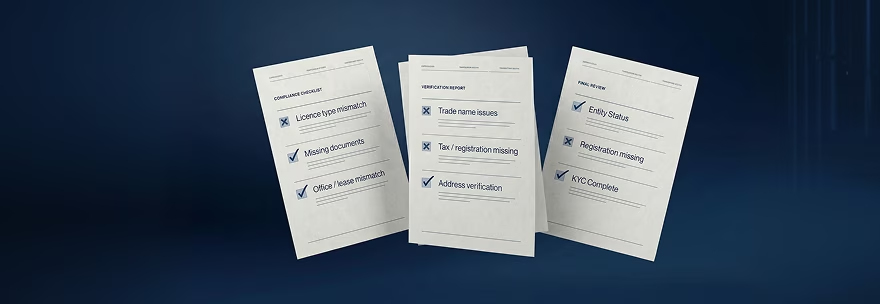
the most common mistakes
Wrong licence type
Chose an activity that doesn't match the business goal — Free Zone licence for mainland trade, or vice versa
Trade name rejected
Name too generic, offensive, or conflicts with existing registrations — forces restart
Document errors
Incomplete MoA, missing translations, passport inconsistencies — delays of 1–2 weeks per resubmission
Missing tax & labour registration
FTA (Corporate Tax) and MOHRE forgotten — can't hire legally or operate compliantly
Office / lease mismatch
Mainland requires Ejari; Free Zone requires zone-approved flexi-desk — without these, application is blocked
Underestimating regulated approvals
Certain activities (RERA, SCA, healthcare) require sector-specific approvals — adds weeks unexpectedly


Frequently Asked Questions
What is the difference between a Mainland and a Free Zone company?
A Mainland company is licensed by the Department of Economy and Tourism. It has unrestricted access to the UAE market. This includes selling to local clients, opening stores, and bidding on government contracts. A Free Zone company is licensed by a specific free zone authority. It works best for international operations and digital businesses. Founders who want 100% ownership without focusing on the local market prefer this option. The right choice depends on your clients and your business plan.
Can a Free Zone company sell to UAE-based clients?
Yes, in many cases. Free zone companies can work with clients in the UAE mainland. This is especially true in digital, consulting, and knowledge-based areas. However, for regular physical trading or retail aimed at UAE customers, a Mainland license is usually needed.
What is an Offshore company, and when does it make sense?
A UAE Offshore company is a legal entity registered in places like RAK ICC or JAFZA. It cannot do business within the UAE. It has no visa entitlement and no physical office requirement. Offshore structures serve various purposes. They hold assets, facilitate international trading, manage IP ownership, and support cross-border investment. They are valued for their confidentiality, low cost, and legal recognition in global deals.
Do I still need a local UAE partner to open a company?
For most business activities, no. The UAE ownership reform of 2021 ended the need for a local UAE national to own most of a Mainland company. Now, foreign investors can fully own most commercial and professional activities. A small number of strategically sensitive sectors still require UAE national participation. Free zone companies have always allowed 100% foreign ownership.
Which structure is best for holding assets or investments?
An Offshore company or a Free Zone holding structure is typically used for asset protection, real estate ownership, IP holding, and investment portfolios. DIFC and ADGM are preferred for sophisticated holding and fund structures due to their common law frameworks and international recognition. RAK ICC and JAFZA offshore are popular for simpler, cost-effective holding arrangements. The right choice depends on the nature of the assets, the jurisdictions involved, and the intended use of the structure.
Types of Companies
The UAE provides various company structures. Each has unique tax benefits, ownership rules, and market access. We match you with the right one based on your business model. Our experts guide you through setup, ensuring you're compliant, optimized, and ready to grow.

Let’s Discuss Your Case
Share your contact details and we’ll reach out to discuss how we can help
Still want to do it on your own?
Download our step-by-step guide and avoid common mistakes when setting up your company