The Core Difference
For years the answer was simple: free zone, because it was the only way to own 100% of your company. That reason no longer applies. Following reforms to the Commercial Companies Law (Federal Decree-Law No. 32 of 2021), 100% foreign ownership is now available on the mainland for most activities, with no UAE national partner required.

So if ownership is no longer the deciding factor, what is? In 2026 it comes down to two things:
- Where your customers are?
- How your income will be taxed?
A free zone company is registered within one of the UAE's designated economic zones — DMCC, JAFZA, IFZA, RAKEZ, DIFC, ADGM and dozens of others, each with its own authority, fee structure, visa quotas and permitted activity list. Setup typically takes one to three weeks when documents are in order.
A mainland company is licensed by the Department of Economy and Tourism in the relevant emirate. It can trade freely anywhere in the UAE, including selling directly to local customers and bidding for government contracts.

The Tax Question: Where Most People Get It Wrong
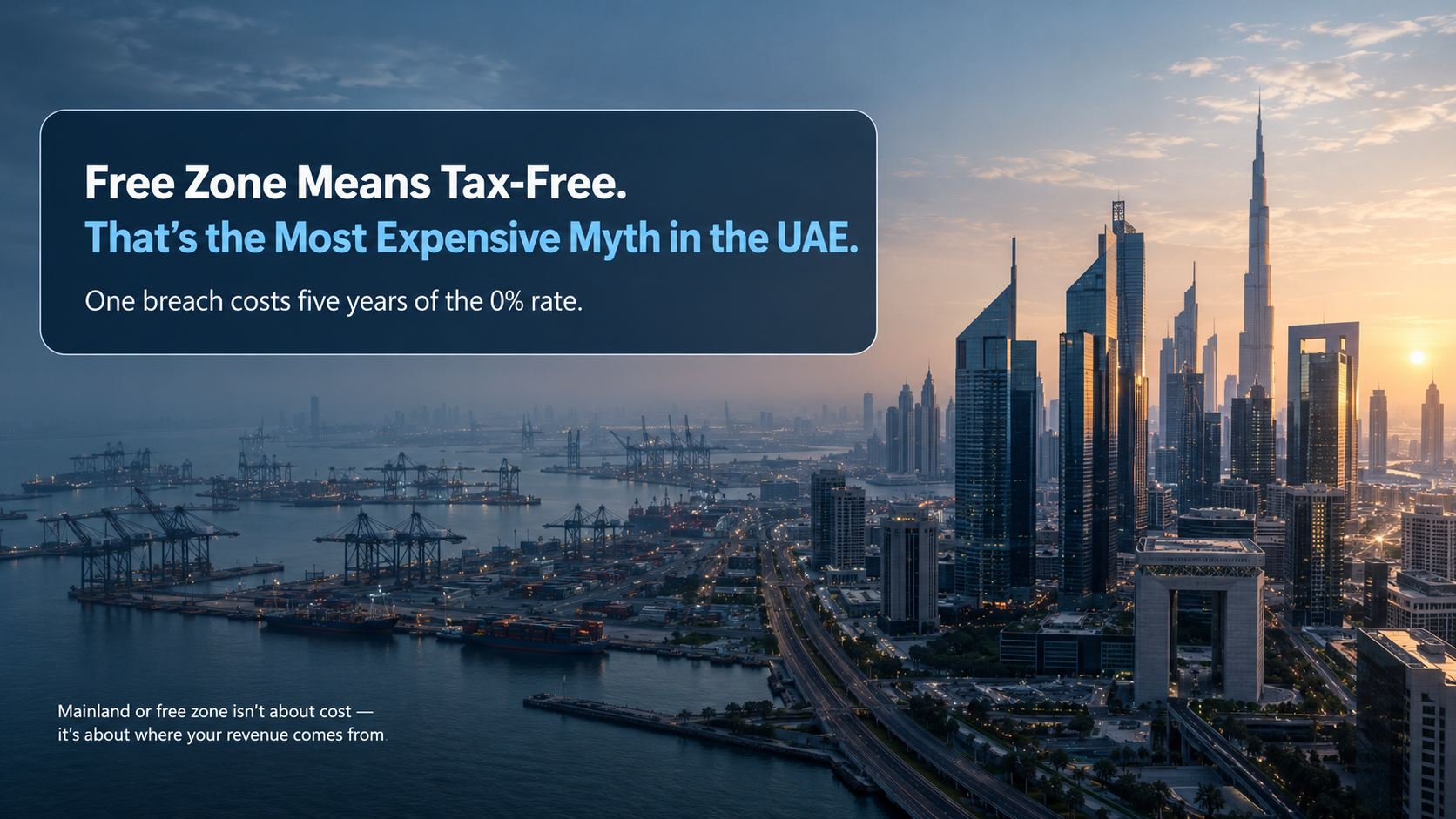
The most persistent myth in UAE company formation is that free zone means tax-free. It does not.
UAE federal corporate tax applies at 9% on taxable profits above AED 375,000, to both mainland and free zone companies by default. It took effect for financial years beginning on or after 1 June 2023.
A 0% rate applies only to qualifying income, and only if the entity meets every condition to be a Qualifying Free Zone Person (QFZP):
- income generally from parties outside the UAE or from other free zone entities;
- adequate substance in the UAE — real office space, employees, operating expenditure;
- non-qualifying income below the de minimis threshold: the lower of AED 5 million or 5% of total revenue.
The critical detail: the test must be passed every tax period, not just at setup. And the penalty is heavier than most expect.
Under Cabinet Decision No. 100 of 2023, breaching any QFZP condition costs the status for that tax period and the four that follow — a five-year lockout. Throughout that window the 9% rate applies to all of the entity's taxable income, not just the portion that caused the breach.
A single year of mainland revenue above the threshold can cost five years of the 0% rate.

Small Business Relief: The Final Year
Separately from the free zone regime, UAE resident businesses with revenue of AED 3 million or less can elect Small Business Relief and be treated as having no taxable income for that period.
The relief is temporary. It is available for tax periods ending on or before 31 December 2026, unless the rules are extended. If your financial year is the calendar year, 2026 is the last period in which you can elect it.
If you are setting up now, this belongs in your first-year planning rather than being discovered after the window closes.
Which One Actually Fits Your Business
A free zone usually fits when your customers are primarily outside the UAE or are other free zone entities, you run an export, B2B services or international trading business, your activity is on the Qualifying Activities list, and you can genuinely maintain UAE substance.
A mainland company is usually better when your customers are UAE-based and mainland-located, you want to bid for government contracts, you need physical retail or industrial premises, or your activity isn't on the Qualifying Activities list — in which case the 0% rate wouldn't apply anyway.
The Honest Summary
There is no universally better option. The decision should follow your business model, not a marketing promise. The question isn't which is cheaper to set up — it's where your revenue will actually come from, and whether you can sustain the compliance position you're choosing.